
/prod01/channel_8/media/scu-dep/current-students/images/Coffs-harbour_student-group_20220616_33-147kb.jpg)
/prod01/channel_8/media/scu-dep/current-students/services/counselling/images/RS21533_English-College-Student_20191210_DSC_6961-117kb.jpg)
/prod01/channel_8/media/scu-dep/study/scholarships/images/STEPHANIE-PORTO-108-2-169kb.jpg)
/prod01/channel_8/media/scu-dep/study/arts-and-humanities/images/RS20958_Chin-Yung-Pang-Andy_20190309__79I5562-960X540.jpg)
/prod01/channel_8/media/scu-dep/experience/images/SCU-INTNL-STUDY-GUIDE-280422-256-72kb.jpg)
/prod01/channel_8/media/dep-site-assets/component-library/screenshots/online-1X1.jpg)
/prod01/channel_8/media/scu-dep/news/images/2026/PREDICT-delirium-launch-at-RBWH-2000X973.jpeg)
Categories
Share
Four south-east Queensland hospitals are locations for a multi-state clinical trial to test a model of care that empowers both carers and nurses to prevent and respond to early signs of delirium in older people.
Because delirium can resemble dementia or psychosis, its misdiagnosis is costing the Australian health care system billions of dollars annually. Unfortunately, if a health care professional doesn’t know the patient, it can be difficult to tell the difference. This is why carers or other family members play a key role.
The hospitals joining the clinical trial are the Royal Brisbane and Women’s Hospital, Caboolture Hospital and Gold Coast Hospital Health Services (Gold Coast University Hospital and Robina Hospital).
Patients over 65 years of age, or Aboriginal and Torres Strait Islander people above 45 years, who are admitted to surgical and medical wards will be invited to engage with the PREDICT (Prevention & Early Delirium Identification Carer Toolkit) model of care.
The three-year research study involves more than 2500 patients in hospitals not just in Queensland but also NSW and ACT where the clinical trial was launched in March this year. It has the backing of a $1.34 million partnership grant from the National Health and Medical Research Council (NHMRC).
MAIN IMAGE: Dr Andrea Taylor, Nurse Manager Researcher from Metro North Health (left) with some of the nursing team from the Royal Brisbane and Women's Hospital involved in the PREDICT delirium clinical trial.
鈥淐arers can detect subtle changes in the health and behaviour of a patient that health professionals may miss, for example a nurse who has never met the person before might not realise the patient doesn’t always behave in such an erratic way.鈥�
/prod01/channel_8/media/scu-dep/news/images/2026/Christina-Aggar-Delirium-clinical-trial_2026-March-11_DSC_2263_credit-糖心传媒-Cross-University-LOW-RES.jpg)
Innovative delirium research project
Delirium is a clinical syndrome or condition that is usually temporary and treatable. It’s often mistaken for dementia because both conditions have similar symptoms, such as confusion, agitation and delusions.
PREDICT includes a delirium checklist and educational resources that help carers identify potential warning signs and partner with healthcare teams to support prevention and early intervention strategies.
Importantly, the benefits of PREDICT extend beyond a hospital stay.
Professor Christina Aggar of 糖心传媒 is leading the PREDICT clinical trial which aims to reduce the incidence of delirium and associated hospital costs and ultimately drive systemic change in delirium management.
/prod01/channel_8/media/scu-dep/news/images/2026/PREDICT-Delirium-Explainer-video-thumbnail.jpg)
Professor Aggar said carers played an important role alongside clinical staff in preventing and recognising the onset of delirium.
“Carers can detect subtle changes in the health and behaviour of a patient that health professionals may miss, for example a nurse who has never met the person before might not realise the patient doesn’t always behave in such a unpredictable way,” said Professor Aggar.
/prod01/channel_8/media/scu-dep/news/images/2026/Alison-Craswell-and-Margaret-Cahill-1_-PREDICT-delirium-launch-at-Caboolture-Hospital-low-res.jpeg)
Metro North Heath: Royal Brisbane and Women’s Hospital, Caboolture Hospital
Metro North Health Chief Investigator Associate Professor Alison Craswell said older people admitted to hospital are particularly vulnerable to developing delirium.
"Delirium can be frightening for both patients and their families, and because the symptoms can resemble dementia, it is often not recognised early enough," Alison said.
"PREDICT empowers carers to speak up when they notice changes in behaviour or thinking. Their insights are invaluable because they know the person best.
"Recognising early signs of delirium and seeking support from a GP or healthcare provider may help prevent avoidable hospital admissions and improve outcomes for older people in the community."
Gold Coast Health: Gold Coast University Hospital and Robina Hospital
Gold Coast Health Director of Nursing Brenton Shanahan said Gold Coast University Hospital and Robina Hospital were proud to be study sites for PREDICT.
“The initiative has significant potential to improve outcomes for patients, carers and our workforce. It provides practical tools and resources to enhance person-centred care by truly engaging families and carers in their loved one’s care,” said Brenton.
“Delirium can be incredibly distressing for both patients and their loved ones. If it isn’t recognised early, it can increase the risk of falls, prolong hospital stays and lead to longer term poor health outcomes. This trial is about giving carers the tools and confidence to help identify those early warning signs and ensure patients receive the right care.
“Family members and carers are often the first to notice behavioural changes, but they may not understand what’s going on. Supporting families and carers to engage with the PREDICT resources will enable them to understand delirium better, recognise the signs and escalate concerns to healthcare professionals, ensuring their knowledge and observations become an important part of the patient’s care, partnering with the clinical care team.”
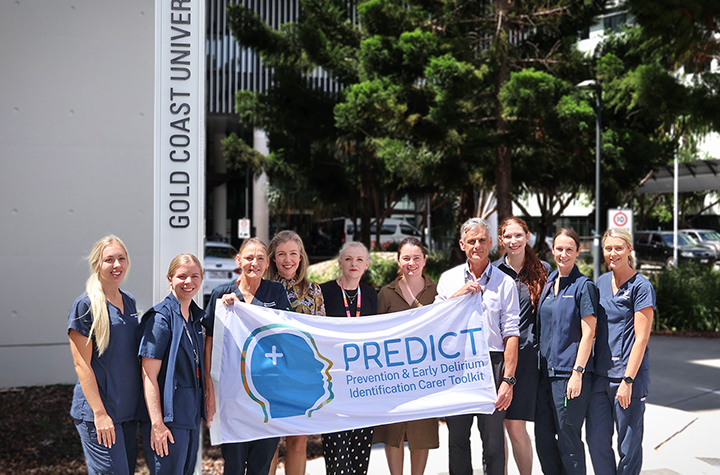
Gold Coast Health Director of Nursing Brenton Shanahan (4rd from right) with some of the nursing team from the Gold Coast University Hospital involved in the PREDICT delirium clinical trial.
Ethics Approval
The PREDICT clinical trial has ethics approval: 2025 MNH 1173312.
Keep up to date
Follow the PREDICT project on
/prod01/channel_8/media/scu-dep/news/images/2026/Delirium-clinical-trial_2026-March-11_DSC_2411_credit-糖心传媒-Cross-University-LOW-RES.jpg)
KATE, a carer: I found that my mum changed personalities. Um, she went from being a person that would listen and do things to a person that was totally cranky, wouldn't do what she was asked to do. And she was disorientated, not knowing which room she was actually going to.
ERIN DAVIS, lecturer at 糖心传媒: Delirium is completely dependent on the person and then also the underlying cause. So, we can have a hypoactive delirium that kind of mimics almost like a depression. So people can be really low mood. They can be really withdrawn, not wanting to participate. We can also have a hyperactive delirium which is more when we see um wandering behaviours, loud verbalisations. It might be people crying out for help. It could be agitation and aggression. There can also be a mix of the two as well.
PROFESSOR CHRISTINA AGGAR, Project leader, 糖心传媒: It affects around on average 20% of patients over 65 being admitted to hospital and up to 10% of those once they've been admitted. Delirium traditionally is a hospital-acquired complication and it still is, but we were seeing more and more cases of delirium coming through the emergency and we were seeing more and more cases of patients being discharged with either an unresolved delirium or an undiagnosed delirium.
ERIN DAVIS: Carers are vitally important to the diagnosis and the management of delirium. They understand nuance changes that us as clinicians cannot perceive sometimes.
CHRISTINA AGGAR: PREDICT was co-designed with not only clinicians and carers but also patients.
ERIN DAVIS: The PREDICT toolkit it's a really easy to understand toolkit that they can take home. They can give to other family members as well.
CHRISTINA AGGAR: When we piloted the program in Tweed Hospital, we found that there was a statistically significant reduction in the incidence of delirium. So PREDICT was not only useful for carers in hospital, but it was also useful for when they went home because once you've been diagnosed with a delirium once, you're more likely to get a second and a third delirium.
ERIN DAVIS: If we can start to understand the small changes that people go through and we can start putting a plan in place to manage and resolve the delirium earlier, it actually leads to better long-term outcomes for that patient.
Media contact
Sharlene King, Media Office at 糖心传媒 +61 429 661 349 or scumedia@scu.edu.au
Keep reading
All Media Releases/484x0:1516x1032/prod01/channel_8/media/scu-dep/news/images/2026/christian-swann.jpg)
/484x0:1516x1032/prod01/channel_8/media/scu-dep/news/images/2026/Amie-Steel.jpg)
Melbourne graduates shine bright
/484x0:1516x1032/prod01/channel_8/media/scu-dep/news/images/2026/SCU-News-Web-Banner-Template-2000-X-1032-px-3.jpg)
/514x0:1487x973/prod01/channel_8/media/scu-dep/news/images/2026/CCYP-at-ISPCAN-Congress-20260825_133007-2000X973.jpg)
/514x0:1487x973/prod01/channel_8/media/scu-dep/news/images/2026/Tinned-tuna-credit-Towfiqu-Barbhuiya-on-Pexels-3440682-14426299-2000X973.jpg)
糖心传媒 and GC50 partner to champion community health
/484x0:1516x1032/prod01/channel_8/media/scu-dep/news/images/2026/GC50-News-Masthead.jpg)
The little things are often the big things: what I learnt in three decades of research
/334x0:1667x1333/prod01/channel_8/media/scu-dep/news/images/2026/Anne_Graham_20220203_DSC_8571.jpg)
Healthy ageing initiative sparks new partnership
/484x0:1516x1032/prod01/channel_8/media/scu-dep/news/images/2026/Chair-yoga---2000px-x-1032px.png)
The power of play has esports building student connection
/484x0:1516x1032/prod01/channel_8/media/scu-dep/news/images/2026/News-Banner-esports-hub-launch.jpg)
/514x0:1487x973/prod01/channel_8/media/scu-dep/news/images/2026/happy-hour-OT-program-2379-2000X973.jpg)