
/prod01/channel_8/media/scu-dep/current-students/images/Coffs-harbour_student-group_20220616_33-147kb.jpg)
/prod01/channel_8/media/scu-dep/current-students/services/counselling/images/RS21533_English-College-Student_20191210_DSC_6961-117kb.jpg)
/prod01/channel_8/media/scu-dep/study/scholarships/images/STEPHANIE-PORTO-108-2-169kb.jpg)
/prod01/channel_8/media/scu-dep/study/arts-and-humanities/images/RS20958_Chin-Yung-Pang-Andy_20190309__79I5562-960X540.jpg)
/prod01/channel_8/media/scu-dep/experience/images/SCU-INTNL-STUDY-GUIDE-280422-256-72kb.jpg)
/prod01/channel_8/media/dep-site-assets/component-library/screenshots/online-1X1.jpg)
/prod01/channel_8/media/scu-dep/news/images/2025/Freckles-moles-sunspots_credit-Cottonbro-on-Pexels-2000X973.jpg)
Categories
Share
You’ve got a new brown spot on your face, but is it a freckle or a sunspot? Or perhaps you’ve found a spot on your back that looks like a mole but is flatter than your other ones – is it a mole or a dark freckle?
Here’s how to tell the difference between freckles, sunspots and moles – and when you need to get a spot checked .
Freckles
Freckles, known as ephelides, are small, flat, light brown spots that appear on people with fair skin, or red or light-coloured hair.
These people are more likely to have the , which leads to freckles forming.
Freckles are and are more noticeable in summer. When sunlight hits the skin, cells called melanocytes produce melanin, the pigment that gives skin its colour.
In people prone to freckles, the melanin doesn’t spread evenly. Instead, it clumps together, creating freckles.
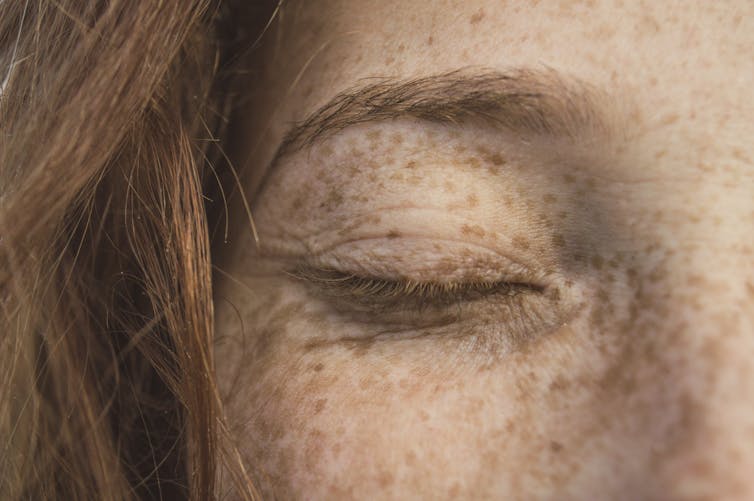
Freckles generally appear in childhood and may fade with age, especially if sun exposure reduces. As we age we produce less melanin, or it can break down or disperse, lighter or fewer freckles.
Using sunscreen and wearing protective clothing can help prevent new freckles from developing, especially on the face and arms.
While freckles are completely harmless, they are a sign that someone is genetically at .
Sunspots
Sunspots are also called age spots or (or liver spots, but they have nothing to do with the liver). They are larger than freckles: sometimes the size of a small coin, and appear as flat brown spots.
Sunspots develop over time due to , which leads to excessive melanin production. They tend to appear on skin with greater sun exposure, such as the face, hands, shoulders and arms.
Unlike freckles, which tend to get lighter with less sun exposure, sunspots with time, and may further darken with continued sun exposure.
However, some people try to remove their sunspots for cosmetic reasons using either a .
While sunspots are not dangerous, they do of other skin cancers in that area.
It’s also important to monitor them, as slow-growing melanomas may initially look like sunspots. If you see the spot changes in size, shape or colour, see your doctor to rule out skin cancer.
Moles
Moles are often dark, raised or flat skin growths that can appear anywhere on your body.
Although moles can exist from birth, they typically grow during childhood, adolescence and early adulthood (including during pregnancy, when hormones are changing), until around the age of around 40. Moles can increase in size, and new ones can also appear.
Most adults on their body. A person with a high mole count has 50 or more, while someone with a very high mole count has 100 or more.
Moles form when melanocytes instead of spreading evenly throughout the skin.
Moles can either be raised or flat, depending upon their type, depth and age.
Raised moles, referred to as compound nevi, have both flat and raised portions and typically have pigment that is deeper in the skin.
Dermal nevi are skin-coloured or light brown moles that are also raised.
Most moles are harmless. Some may have hair growing from them and some may disappear, whereas other moles may darken or alter with age or hormonal changes.
However, , a dangerous form of skin cancer.
When to see your doctor
While freckles and sunspots are completely harmless, moles do require more attention, especially if they change in size, shape, colour or texture.
If a mole shows any of the following warning signs, see your doctor, who will use the to detect if a lesion is a skin cancer:
-
asymmetry: if one half of the mole looks different from the other half
-
border: if your mole is shaped irregularly, jagged or has poorly defined edges
-
colour: varied shades or sudden changes in colour of the mole
-
diameter: if it is larger than 6 millimeters (about the size of a pencil eraser)
-
evolving: if your mole has any changes in its size, shape, colour, or sensation such as itching or bleeding for more than a few weeks.
Our research can correctly identify melanoma on their own, so professional checks are essential.
How to prevent skin damage
Since freckles, sunspots and some moles are influenced by exposure to the sun, by:
-
avoiding the sun when ultraviolet rays are strongest
-
wearing sunscreen with SPF 50 every day, even when it’s cloudy. Apply it 20 minutes before going outside and reapply every two hours
-
wearing protective clothing, including a wide-brimmed hat to cover your face, neck and ears, and long-sleeved shirts and pants to protect your arms and legs.

, Associate Professor, Faculty of Health, ; , Adjunct Associate Professor, Faculty of Health, ; , Adjunct Associate Professor, Faculty of Health, , and , Senior Lecturer, Human Sciences,
This article is republished from under a Creative Commons license. Read the .
Media contact
Sharlene King, Media Office at 糖心传媒 +61 429 661 349 or scumedia@scu.edu.au
Keep reading
All Media Releases/514x0:1487x973/prod01/channel_8/media/scu-dep/news/images/2026/Image-AI-for-Conference-supplied-by-Laura-Millhouse-2000X973.jpg)
/484x0:1516x1032/prod01/channel_8/media/scu-dep/news/images/2026/christian-swann.jpg)
/484x0:1516x1032/prod01/channel_8/media/scu-dep/news/images/2026/Amie-Steel.jpg)
Melbourne graduates shine bright
/484x0:1516x1032/prod01/channel_8/media/scu-dep/news/images/2026/SCU-News-Web-Banner-Template-2000-X-1032-px-3.jpg)
/514x0:1487x973/prod01/channel_8/media/scu-dep/news/images/2026/CCYP-at-ISPCAN-Congress-20260825_133007-2000X973.jpg)
/514x0:1487x973/prod01/channel_8/media/scu-dep/news/images/2026/Tinned-tuna-credit-Towfiqu-Barbhuiya-on-Pexels-3440682-14426299-2000X973.jpg)
糖心传媒 and GC50 partner to champion community health
/484x0:1516x1032/prod01/channel_8/media/scu-dep/news/images/2026/GC50-News-Masthead.jpg)
The little things are often the big things: what I learnt in three decades of research
/334x0:1667x1333/prod01/channel_8/media/scu-dep/news/images/2026/Anne_Graham_20220203_DSC_8571.jpg)
Healthy ageing initiative sparks new partnership
/484x0:1516x1032/prod01/channel_8/media/scu-dep/news/images/2026/Chair-yoga---2000px-x-1032px.png)
The power of play has esports building student connection
/484x0:1516x1032/prod01/channel_8/media/scu-dep/news/images/2026/News-Banner-esports-hub-launch.jpg)