/prod01/channel_8/media/scu-dep/current-students/images/Coffs-harbour_student-group_20220616_33-147kb.jpg)
/prod01/channel_8/media/scu-dep/current-students/services/counselling/images/RS21533_English-College-Student_20191210_DSC_6961-117kb.jpg)
/prod01/channel_8/media/scu-dep/study/scholarships/images/STEPHANIE-PORTO-108-2-169kb.jpg)
/prod01/channel_8/media/scu-dep/study/arts-and-humanities/images/RS20958_Chin-Yung-Pang-Andy_20190309__79I5562-960X540.jpg)
/prod01/channel_8/media/scu-dep/experience/images/SCU-INTNL-STUDY-GUIDE-280422-256-72kb.jpg)
/prod01/channel_8/media/dep-site-assets/component-library/screenshots/online-1X1.jpg)
Rainbow Inclusive Aged Care - Research Updates
/prod01/channel_8/media/scu-dep/research/images/rainbow-aged-care-masthead.jpg)
Research Update June 2026
/prod01/channel_8/media/scu-dep/faculties-and-colleges/health/images/AdobeStock_491049142_square.jpeg)
What enables and constrains rainbow inclusive aged care?
To answer this question in the project’s Stage 2 Discover, we collected data in two ways:
- Fieldwork observations and interviews with residents, visitors and staff working in 12 Wesley Mission Qld and Amana Living residential aged care homes in QLD and WA, and
- National survey of staff, volunteers, students and professionals visiting residential aged care homes across Australia.
Throughout 2026, our Communities of Practice will continue to meet every 6-8 weeks to review, workshop, analyse and interpret the data. Early insights from these discussions are included in this update. Enablers and constraints on rainbow inclusion will be discussed with the Lived Experience Advisory Group and the National Reference Group in June and are therefore not included. Here, we include early insights into practices associated with rainbow inclusion from fieldwork and some headline results of the national survey.
/prod01/channel_8/media/scu-dep/faculties-and-colleges/health/images/AdobeStock_249280492_Square.jpeg)
Fieldwork early insights
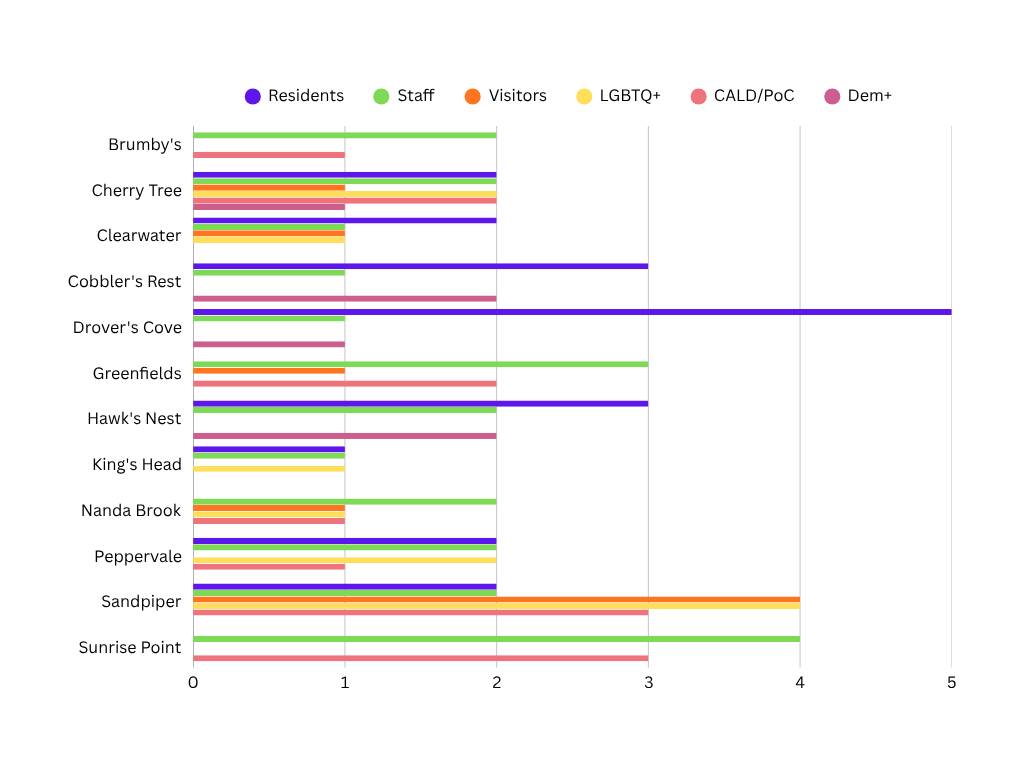
In 2025, over 100 hours of observations were conducted by 7 researchers aged 25-85 years, and de-identified descriptions of the homes will be provided in our October research update. Interviews were conducted with 51 participants: 20 residents, 23 staff and 8 visitors. Eleven participants self-identified as LGBTQ+ (5 staff, 3 residents and 3 visitors), and 13 staff self-identified as culturally and linguistically diverse, or people of colour. Of the 20 residents, 6 self-identified as living with dementia or other cognitive impairments.
Staff participating in the interviews came from a range of roles, including allied health (9), nursing (5), manager (4), personal care (4) and hospitality (1). Allied Health roles included: Physiotherapy, occupational therapy, leisure and lifestyle or activities coordinator, allied health/OT assistant, chaplain, social worker. The diversity of participants at each site is illustrated in Figure 1.
A. Rainbow inclusive practices
The practices that fieldwork participants associated with rainbow inclusive aged care are summarised in Table 1. They highlight the common humanity of the diverse people living, working in, or visiting residential aged care homes. Notably, all of these practices involved mutuality/reciprocity, rather than care being a one-way ‘service’ between carers, residents, visitors and managers.
Table 1: Early insights into practices associated with rainbow inclusion by fieldwork participants
|
Residential aged care inclusive practices |
Descriptions of practices |
|
Caring for others and being cared for |
These practices were associated with being welcoming, feeling accepted without stigma, being kind and empathetic, trusting and being trusted, being respected, respecting and mattering to others. |
|
Connecting with others |
Connecting practices involved being present, being friendly and building relationships, listening, sharing stories and learning about each other, reminiscing and remembering, being socially connected and motivating others. |
|
Having and helping others to have a good day/life |
These wide-ranging practices included personal, health and mental health care, spiritual and pastoral care, as well as enjoying food, being and feeling safe, feeling emotionally supported, making a contribution, informed decision making, and pastimes or recreational activities that align with resident preferences, both in groups, one-to-one, and alone. A standout here was being funny and having fun. |
|
Practices at different stages |
Related to practices associated with: a. transitioning in, like learning the ropes, experiencing a range of emotions and losses, and building trust b. day-to-day life, like participating in enjoyable and meaningful activities, having visitors, and changing relationships over time and c. end-of-life practices, which included making people comfortable, knowing and enacting people’s preferences for a good death, managing family tensions and conflict, supporting residents, visitors and staff through grief, loss and bereavement. |
B. Conditions enabling and constraining rainbow inclusion
Notably, fieldwork participants associated with rainbow inclusion with both:
- inclusion for all (on the basis of diversity in ethnicity, age, faith or spiritual background, cultural background, disability and different roles/ positions), and
- inclusion for current and future LGBTQ+ residents, visitors and staff.
/prod01/channel_8/media/scu-dep/faculties-and-colleges/health/images/AdobeStock_274060545_square.jpeg)
National survey headline results
The Pride in Our Work survey aimed to identify the individual and organisational factors that enable or constrain inclusive practice in residential aged care settings, including participants’ knowledge, training, experience, workplace climate, and perceptions of safety and inclusion.
The national online survey was open between August 2025 and February 2026 to people aged 18 and over who work, volunteer, visit professionally, or are on placement in residential aged care in Australia. A total of 648 individuals took part, including 209 staff working in our partner organisations Amana Living and Wesley Mission Queensland.
Who participated?
Participants represented a broad range of roles across residential aged care and came from every Australian state and territory. Most participants were women, and the sample was culturally diverse, with more than two in five participants born overseas.
Gender: Woman (536, 82.8%), Man (95, 14.7%), Non-binary (8, 1.2%)
Age: 18-29 (52, 8.0%), 30-39 (138, 21.3%), 40-49 (132, 20.4%), 50-59 (168, 25.9%), 60+ (158, 24.5%)
State or territory: ACT (8, 1.3%), NSW (108, 17.7%), NT (3, 0.5%), QLD (91, 14.9%), SA (27, 4.4%), TAS (11, 1.8%), VIC (113, 18.5%), WA (250, 40.9%
Country of birth: Australia (335, 53.7%), Overseas (267, 42.8%)
Role in residential aged care: Nursing and medical (212, 32.9%), Caring and allied health (174, 27.0%), Volunteers and students (106, 16.4%), Management and leadership (73, 11.3%), Administration (41, 6.4%), Hospitality and maintenance (39, 6.0%)
Initial Results
Initial results suggest a strong foundation for rainbow inclusion in residential aged care. Participants strongly agreed that they have a role to play in providing safe, welcoming and inclusive care to everyone in residential aged care, with an average score of 4.49 out of 5 (with 1 being strongly disagree and 5 being strongly agree). Overall confidence in meeting the needs of LGBTQ+ residents was also positive, with an average score of 3.71 out of 5. Participants reported high willingness to engage in practical inclusive practices, particularly using inclusive language (Table 2).
|
Inclusive practices |
Willingness average score |
|
Use words like “partner” instead of “husband” or “wife” |
4.39 / 5 |
|
Attend a diversity day event |
4.26 / 5 |
|
Ask if a resident wants to be called he, she, they, or something else |
4.21 / 5 |
|
Put a rainbow flag or sticker on a name tag or lanyard |
4.08 / 5 |
|
Put pronouns on a name tag or lanyard |
3.62 / 5 |
At the same time, visible signs of inclusion were not consistently observed. More than two in five participants reported that they had not noticed any of the listed signs of rainbow inclusion in their workplace (Table 3).
|
Have you noticed these signs of LGBTQ+ inclusion? |
% |
|
Rainbow flags or stickers in common areas |
27.5 |
|
Organisational diversity statement |
26.8 |
|
LGBTQ+ inclusion policy or action plan |
20.2 |
|
Acknowledgement of LGBTQ+ community events |
17.4 |
|
None of these |
42.6 |
Overall, the findings suggest that many staff and volunteers in residential aged care are supportive of rainbow inclusion and willing to take practical steps to support residents, staff and visitors.
Next steps
The next stage of the survey will involve further analysis of the data to better understand what may enable or constrain rainbow inclusive practice in residential aged care. This will include exploring relationships between demographic, workforce and organisational factors and their willingness or ability to engage in inclusive practices.
These analyses will help identify where support, training and resources may be most needed across the sector. We will also consult with the project’s Lived Experience Advisory Group and Communities of Practice to help guide the analysis, interpret emerging findings, and ensure the results are meaningful and useful for people working in residential aged care and the LGBTQ+ communities they support.
/prod01/channel_8/media/scu-dep/faculties-and-colleges/health/images/Margaret-and-Cecily_Final2.jpg)
Cecily and Margaret: on love, commitment, and mattering to someone
Cecily and her partner Margaret were together for 41 years. Cecily was Margaret’s carer when she joined the project’s Lived Experience Advisory Group in 2024. Margaret sadly passed away last year. Since then, Cecily has established a rainbow-inclusive grief support group in her community, while continuing to support our Rainbow Inclusive Aged Care co-creation process. Cecily shares her experience of caring and the need for safe, LGBTQ+ spaces for healing.
Cecily: Margaret was 55 when we met. As she wrote in one of her letters, she was concerned because I was 13 years younger, I mightn't have the stick ability when she got old. But I’m a stayer. So, we had a commitment from the beginning that we would be together. When she got the Alzheimer's diagnosis, we both just knew that she would die at home. That was always going to be how it was. And so, we got onto the palliative care team who said they would support us at home.
I had no idea what the journey would entail, really. I had a vague idea that she'd lose her memory and become more frail. But in fact, it was enormous. She lost all these wonderful abilities she’d had. She became more and more disabled and needed 24-hour care. And I was up for it; I'm really glad I did that. People from the outside saw, perhaps more than I did, the size of this thing that we were doing together. Both of us had the same aim, which was to keep her alive. She was very determined about that. My aim was to keep her as comfortable and as happy as she could be while alive.
I cared for her with Alzheimer’s for seven years, but the last three were very intense because she became completely incapacitated. I suppose it was demanding on me although it didn't feel demanding. This was my task, and I was completely focused on it. I was happy doing it. I wanted her to live. I still want her to be here. Somebody said to me this morning, ’I guess she's no longer suffering’, but she didn't suffer. I said, ‘I'd much rather have her here with me’.
That journey ended terribly abruptly, and in the end, I was not prepared at all. She died with agonal breathing, which was horrible for me. The funeral director came in the middle of the night on the night she died and put her on a gurney and zipped the black bag up over her face and walked out the door with her. In a way, I never recovered from that.
Then the funeral happened and my son and daughters came, and they were wonderful. We wanted to honour her, and I think we did that. But then that was gone and all the kids went away, and I was still here in this house with just her cat and me. I had lived in this intense relationship for 41 years, but I hadn't thought about what my life would be after she had gone. The thing that kept coming to me was this existential question: what's the point? What's the point of me? You know, I've passed my use-by-date, I've brought up three children, so that's the law of nature, and I've done this enormous thing. And now I'm redundant. I was lost, for a while.
That existential question hung around until I realised I need people who understand this – I need gay people who understand this. So, I went to the and asked if they knew of a grief group in the Sunshine Coast. And they said, ‘No, but why don't you start one?’ So, we put out a notice, and soon we had our first get-together. Quite a few people came along, but I remember David [1], he was memorable because Margaret had not long died and David's partner Peter, he was quite young, but he just died suddenly in the middle of the night. So, he and I were there together really.
So that grief group has now expanded and we meet once a month. They’re mostly men who come along. I don’t know what it is about lesbians, but gay men seem to be able to do this stuff better. Those men are wonderful; they give me so much and I know I give them so much. It’s just … we just we see each other because we've all been through the queer journey and we understand. I could have joined an ordinary grief group but we’re in a different culture, the queer community. All of the people in the grief group have lost partners who have they've had for a long time and who they've dearly loved. You could say that about anyone, but there's a there's something about being in queer community - I understand them and they understand me.
The last one we had, which was only last week, we talked about sex. One of the fellas has been a widow of three years, and he'd had some sex with somebody. And that got us into talking about sex and they got into telling me all about the beats in a way that felt absolutely fine and lovely, because there was no judgment. No one cared, except someone said, ‘oh you're such a slut’, and it was that level of humour that could come in, in a kind way. And then we’re all saying, ‘here, look at you, aren't you a slut?’ [laughing]
And we talked about sex. I'd read some article where some one is saying, ’Sex dies, you know, as you get older, older people don't have interest in sex’. And I was saying, I don't believe that at all. I can still see a woman walking past and think, oh, I wish Margaret was here. I can still feel that feeling. And [in the grief support group] we could talk about that. So, there's this trust in the intimacy, I suppose, which is amazingly healing.
Meaghan: Sounds like there’s this sense of ‘I'm not exotic or creepy’; it's just us queers, and we get it?
Cecily: Yeah, that's right, you're not exotic, and you're not creepy, and I can talk about having a sex drive still, and they understand that perfectly. It’s healing. There’s no overlay of disapproval. I've got lots of friends who are heterosexual women, but I wouldn't say that to them.
Meaghan: how did you like advertise the group and what do you do when you get together? How did you figure all that out?
Cecily: We advertised it on Facebook via the LGBTI Community Ageing Network. And we also do it through word of mouth. They remind people every week, and we meet where everything happens at in Nambour. The Woombye bakery is nearby, and they would order the most delicious morning tea, so we wouldn't need to eat for the rest of the day. But it wouldn't matter if we didn't have that really. Everybody is there to get the comfort and the … this time together. It's like magic. As a psychotherapist, I know that my task is to hold the space and keep a safe space.
Meaghan: So, what can we learn from this for residential aged care, where there may just be a few out LGBT people, if we're really lucky. How do we find that sense of solidarity or camaraderie in that setting?
Cecily: It's only by making the connection. And wouldn't it be lovely to have a grief group in an aged care home for gay people, queer people? You don't need any more than two people and one who's aware of holding the space really, so that the other person feels safe enough. But that would be very difficult because there's always the outside judgment coming in. It could only be done one-to-one, but I think that's quite possible.
At our last Lived Experience Advisory Group we talked about some of the reasons that residents, visitors and staff in aged care homes aren’t out, and maybe don’t want to ‘identify’ as LGBTQ+. And I said shame. If you think about it, every time who you are is denied - every time you’re taught ‘little girls don't wear trousers, and little boys don't want to play with dolls and dress up and put lipstick on’ - every time that happens, there's grief, every time. There'd hardly be any child who's grown up where it's completely acceptable. And particularly in the gay community, there is so much family estrangement. So, I would really like to see how we could attend to that.
It was always very important to me that Margaret, right till her last breath, knew she had an important place in this world. No matter how disabled she became, she had a legitimate place in her family, with her friends and the wider community. And she was loved. That’s true for aged care residents, staff and visitors, too. We all need to feel that.
[1] Names have been changed to provide anonymity
/prod01/channel_8/media/scu-dep/faculties-and-colleges/health/images/ageing-australia-v1.png)
Engaging people’s passion and solidarity in human dignity: implementing rainbow inclusive aged care across Australia
Representing partner on our National Reference Group, Julie Anderson brings a wealth of experience and expertise in aged care, innovation, policy and change management. Julie shared her thoughts on the opportunities for implementing a rainbow-inclusive model of aged care across the mainstream aged care sector in a complex and changing environment.
Everyone’s saying it: there’s lots of change happening in aged care right now. From new legislation, to policy, standards, communications, infrastructure, funding, reporting and practice. As , Julie is keen to see a more embedded, authentic process of change:
“Reforms are often driven by forms and compliance. We need to be careful that this doesn't become another ‘tick the box’. How can we engage people and inspire practice that fundamentally reflects the human rights and person-centred foundations of the new Act and standards?”
Aged care advocacy shines a light not only on deficits in the provision of care, but also what is needed for high quality care. In the context of ongoing change, Julie recommends leveraging the Aged Care Act 2024 and standards by highlighting aged care providers’ passion and drive to deliver quality, safe care.
“So, it's not just another piece of work,” says Julie. “We need to embed rainbow inclusion in existing quality systems reform, rather than being a completely stand-alone initiative. Having said that, I do believe rainbow inclusion requires and deserves its own focus as well.”
The project’s Communities of Practice and Lived Experience Advisors are exploring how to build cultural safety in aged care, while also articulating conditions and practices that address the unique needs of LGBTQ+ residents, staff and visitors. Julie suggests using case studies to illustrate best practice in response to complex scenarios.
Getting the messaging right is really important, in the context of our own internal biases, organisational values and history, policy and procedures, that all influence how people relate. Learning from outside the aged care sector is a great way to do that, drawing on the stories of people with lived experience of positive change.
On the subject of training, Julie stresses the importance of using existing learning management platforms, like the platform, to ensure easy access.
"People need those practical tools and a safe space for asking and reflecting on aspects of inclusion they find difficult. We're not always going to get it right with inclusion, but what we need is that kind of learning experience and that ‘we will walk this path together approach’ that is a culturally safe, respectful environment that respects the dignity and rights of every human being."
This resonates with suggestions from interview participants in the Rainbow Inclusive Aged Care Project so far. Implementation science is one platform of the project’s methodology. It’s a process that supports the systematic uptake of research findings into practice across different health and aged care settings. The approach draws on the power of partnering with people in change that matters to them and setting the right conditions for improved practice for everyday people.
“It’s that solidarity piece” says Julie, “we’re all driven by passion and purpose. And that comes down to organisational leadership and change management, whether it’s about psychologically safety or rainbow inclusion."
/prod01/channel_8/media/scu-dep/faculties-and-colleges/health/images/Max-image-volunteer-week-2026_updated.jpg)
Calling all LGBTQ+ community: volunteering in aged care keeps you young!
Max Primmer usually attends our Lived Experience Advisory Group meetings wearing a hoodie as bright as the sun. He drives several kilometres in rural Victoria just to find a mobile phone signal to connect into Zoom. And he’s been advocating for LGBTQ+ inclusion, celebration and equity for over fifty years. Now aged 77, Max is a constant reminder that meaningful connection, humour and joy are essential for older LGBTQ+ people living in rural and regional residential aged care.
Max volunteers at two rural residential aged care homes, supporting social connection, recreational activities, and community excursions. He recently appeared on ABC Back Roads’s from his beloved Hepburn Springs, located on Dja Dja Wurrung Country near Daylesford, Victoria.
Max’s drag persona Di Alysis raises awareness about the needs of gay men experiencing kidney disease through Daylesford’s rural LGBTQ+ festival. Max explains how volunteering in aged care keeps him feeling fabulous, and how providers can improve rainbow inclusion for all.
Meaghan: So, what does volunteering in aged care look like for you?
Max: I go to each home once a week for a couple of hours. I like being able to bring a laugh and generally connect with people, making the day a bit brighter. We see the adverts [for residential care], and everybody's having a fun time. But it’s not that simple for our community in rural areas.
Some people don't leave their rooms. That can be for various reasons. Let’s say you move in, and there's a person sitting opposite you at breakfast who you've had a feud with for the last 30 years. Or maybe you’re hearing impaired and it’s really hard to hold a conversation because there’s so much background noise in the dining room. So, you’d rather have lunch in your room and enjoy that, rather than dealing with the group.
I go into the more isolated people’s rooms and have a bit of a chat about something that’s important to them. One lady started losing her eyesight and was very upset that she couldn't read anymore. So, I got hold of a second-hand radio cassette player, found some earplugs at home, and now she’s listening to audiobooks. Our local library has a great variety, and they deliver right to the home.
For every little bit I put in as a volunteer, I get 100% back in talking to the residents. I love listening to their stories. I might ask ‘what was your life like when you were 16?’, ‘what was family life like?’ Or, if it’s safe for them, ‘Did you come out to your family?’, ‘How did you connect with other rainbow people?’ No one talks about what their life was like 99 years ago, and those stories are going to be lost. How did they cope?
What I’ve learned through all this is to love yourself first. A lot of people in our community do not love themselves because they've always been told they're not worthy and shouldn't be living ‘that sort of life’. It gets into your psyche after a while, and it can stop you from living life. So, whenever I get the chance, I speak about how I've travelled with it and accepted myself: It doesn't matter who you love, you're still a person who is vital. You are loved, and you are important in the world. You're not going to live a good life if you keep hiding away. You've got to be yourself. You're as good as anybody else in the world.
Meaghan: You’ve been very involved in building rainbow-inclusive residential aged care. What can mainstream residential aged care -the NGOs, faith-based, or corporate-run homes - what can they learn from Hepburn House?
Max: We can’t just rely on organisations to know how to work sensitively. It’s important to go through the so that providers learn what quality service looks like for LGBTQI+ people, from the first phone call to care coordination and supported decision-making. Then you can put a few stickers up and employ some LGBTQ+ people or allies. Our leisure and lifestyle coordinator is a gay man, so his photo is up around the place with a rainbow flag on it. That might seem like a small thing. But two people came to me - they didn't out themselves - but they said, ‘That makes me feel so comfortable’.
At a wider societal level, we also need to relish people in their later years, whether or not they’re ‘out’. They are the ones who built our communities and won our LGBTQ+ rights. They might have been married with children, but had a same sex partner on the side. We don't know all the stories. We've really got to get into respecting all the people that come into aged care, taking care and providing them with real meaningful activities.
Aged care homes need to hire a social coordinator who can get to know each person and make up a calendar of activities. Then it goes on everyone’s wardrobe, so as soon as they go past the wardrobe, ‘oh, bingo's on at 3 today, I'll go down and play that’. Or ‘there's music on in the other room; I'll go and listen’. Find someone who can play the guitar and sing a few songs. Get people up moving around. They might have restricted mobility or dementia but everyone can enjoy a band playing songs from their era. Frank Sinatra, Dean Martin, Cilla Black, anything that just gets the memory going.
We need to do lot more to keep people engaged, but also to feel connected to a sense of community. You can put people’s names on the door, along with something about their hobbies. One lady likes to colour with books and felt pens. So, she has a few drawings up beside her name on her door. It connects people.
Forget the ‘I’m 94 now, I shouldn't be doing this sort of thing’. Yes, you should! If you've got the energy, you can do anything you want. We need to really enable people to live their lives to the fullest, right to the end.
I know bingo's been around for 10,000 years, but it can be a hoot to play. I've seen the excitement on people’s faces when they win and go through that little basket and pick out a Freddo frog. We just had St. Patrick's Day, so we played Irish-themed bingo: cards made up with leprechauns and four-leaf clovers, a pot of gold at the end of the rainbow and that sort of stuff. That's fantastic. Everybody has a cup of tea and a bickie. If they have time in the kitchen, they'll make homemade bickies. And everybody just has an absolute ball.
And if you’re more of a loner, then that’s where I come in. More of the one-to-one. I know I'm pretty over the top, but I walk in there and just say, ‘I'm Max,’ and then just have a chat for five minutes. Even if they forget me later, I’ve made an impact for those five minutes.
Meaghan: What about rural areas? How can rural and regional communities contribute to rainbow inclusion in residential aged care?
Max: Volunteering is one of the most important things you can do; get involved in some way and make a difference. I help out because it gives me joy. It's about getting involved and being who you are. I don’t ask if they are LGBTQI, but everybody knows who I am. They can connect with that.
Go and listen to the people who live there, what their life is like, what's happening with their lives now. It can be as simple as helping to move people’s wheelchairs – they’re mostly manual – to the activities or into their room, listening to a book. All you’ve done is move a wheelchair, but you've made their day, so they’re not just sitting in front of a TV, nodding off.
Meaghan: Some LGBTQ+ people care for their partner at home right to the end of life, but they might be left with little social connection and support. How could residential aged care become a real option for LGBTQ+ partners towards end of life?
Max: This is a really tough one because everybody's so different. I’ve known plenty of couples in that situation. At home, they know their partner will be treated with respect. They’re worried he won't get the same care and dignity in residential care. But then what if the carer gets sick? A gay couple I know, one has gone into aged care with significant dementia. They’re settling in. It helps that his partner knows another resident, who thankfully, doesn't have a drama about it all. That’s a big hurdle to get over and a big difference we've got to make with this research.
Meaghan: Max, thank you for who you are and all the things that you contribute. I only know a tiny proportion of it. But doing this work, I really do feel I stand on the shoulders of giants.
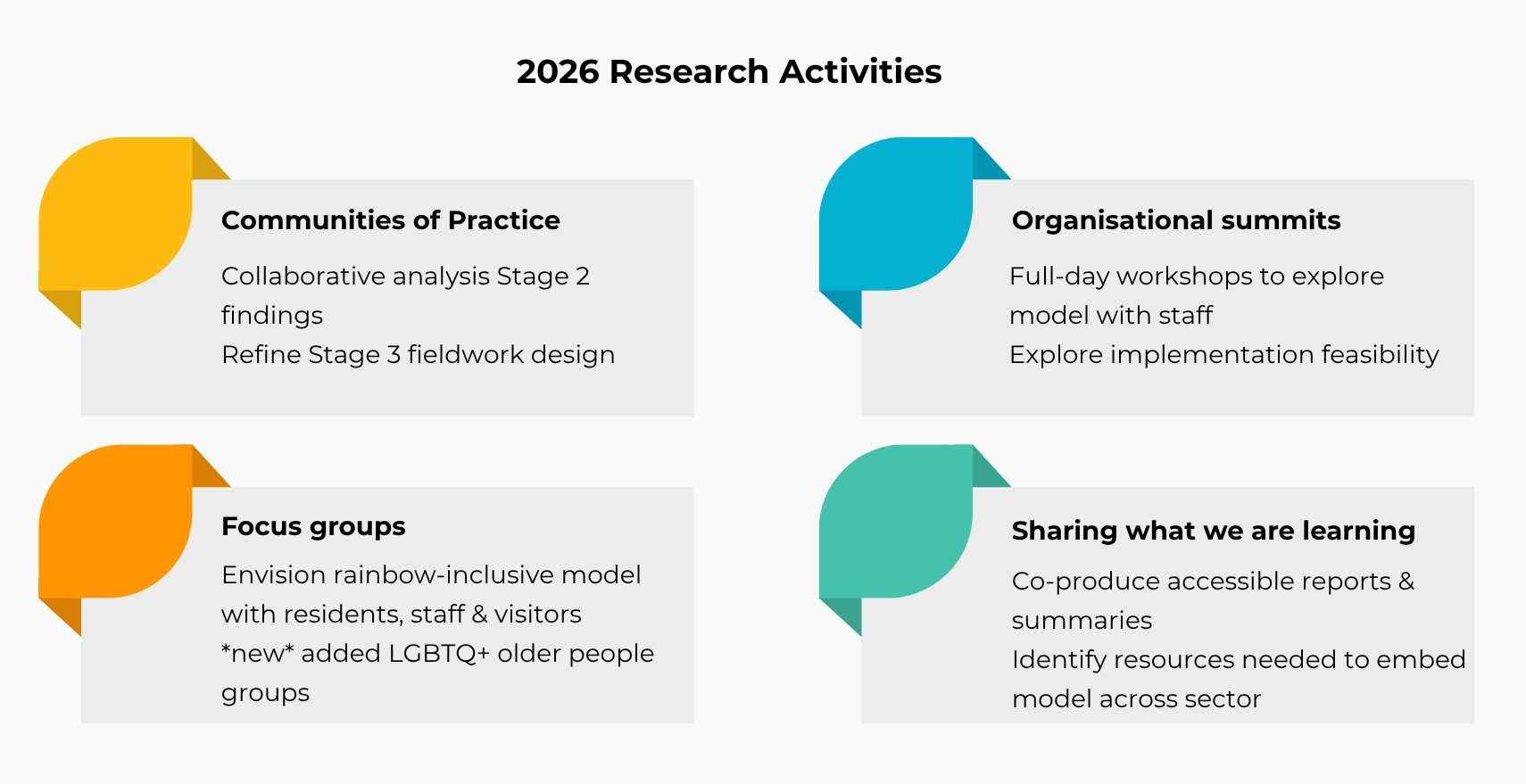
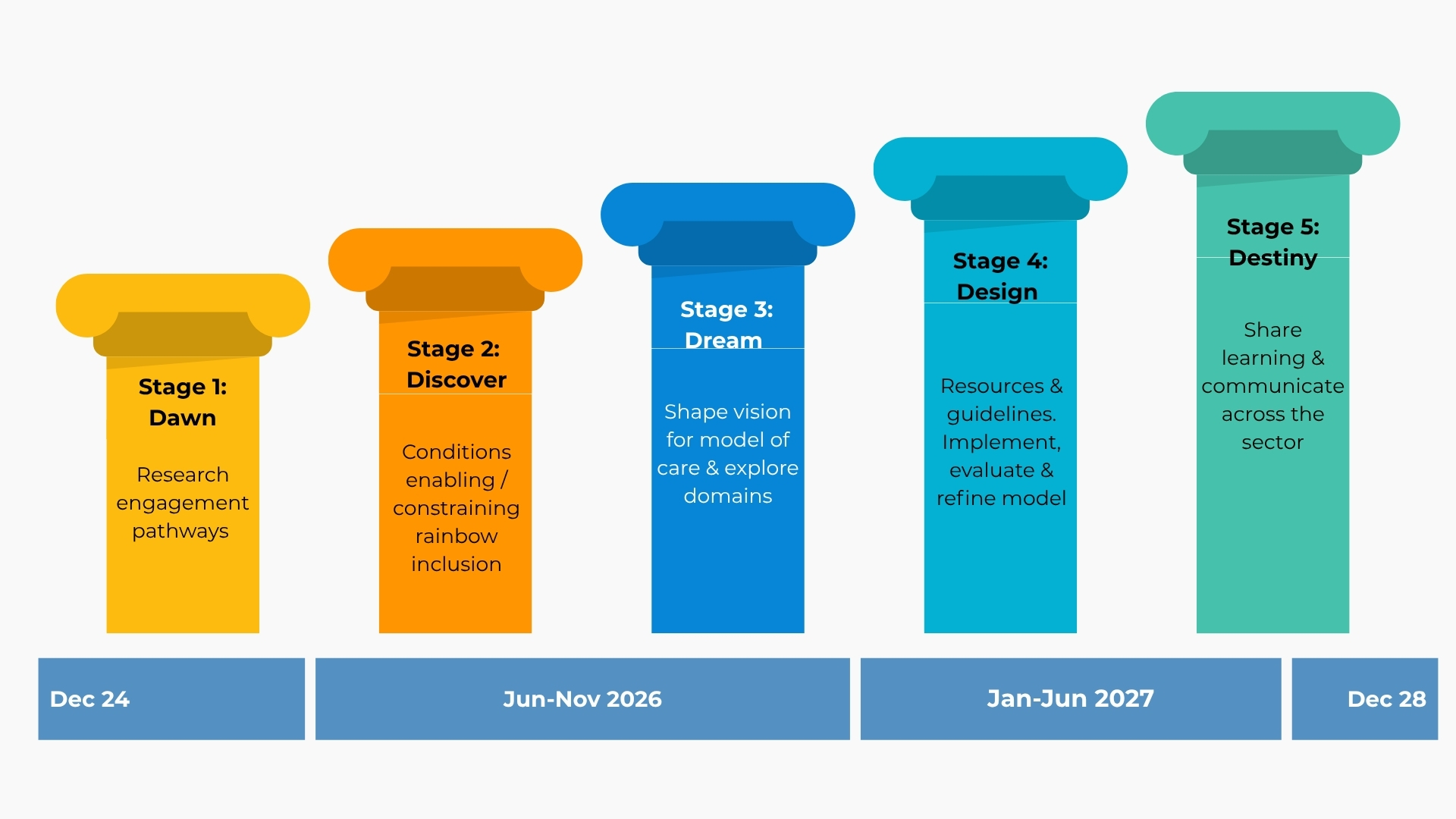
Project activities and milestone update