
/prod01/channel_8/media/scu-dep/current-students/images/Coffs-harbour_student-group_20220616_33-147kb.jpg)
/prod01/channel_8/media/scu-dep/current-students/services/counselling/images/RS21533_English-College-Student_20191210_DSC_6961-117kb.jpg)
/prod01/channel_8/media/scu-dep/study/scholarships/images/STEPHANIE-PORTO-108-2-169kb.jpg)
/prod01/channel_8/media/scu-dep/study/arts-and-humanities/images/RS20958_Chin-Yung-Pang-Andy_20190309__79I5562-960X540.jpg)
/prod01/channel_8/media/scu-dep/experience/images/SCU-INTNL-STUDY-GUIDE-280422-256-72kb.jpg)
/prod01/channel_8/media/dep-site-assets/component-library/screenshots/online-1X1.jpg)
/prod01/channel_8/media/scu-dep/news/images/2026/wheelchair.jpg)
Categories
Share
Wheelchair users have never had better opportunities to access mobility technology, sporting opportunities and accessible destinations across Australia. But how much do we really know about the unique physical challenges faced by both everyday and elite users? New research offers useful advice - starting with something as fundamental as where you sit.
More than one in seven Australians with disability use a mobility aid. From canes to wheelchairs, there are plenty of products available, but how much do we actually know about how each of them function?
Occupational therapist, researcher and Coffs Coast local Lisa Couzens and her team at 糖心传媒 are mapping specific physical challenges that come with life in a wheelchair.
One of the most overlooked is also one of the most mundane: when you’re in a wheelchair, and it’s hot - what happens to your skin? And what do cushions have to do with it?
Built for comfort and speed. But what about heat?
For wheelchair users living active lives, the conversation about injury prevention usually starts and ends with pressure.
But research published earlier this year by Lisa and her team reveals another risk factor: the microclimate of heat and moisture trapped between a wheelchair cushion and the person sitting on it.
Quick facts
Skin that stays warm and damp is skin under stress. Elevated temperature accelerates tissue breakdown, while moisture softens the surface, making it far more vulnerable to damage.
In a humid climate like ours, where temperatures routinely sit at 28-30°C and the air already carries significant moisture, conditions can become genuinely harmful - particularly for wheelchair users who may have reduced sensation and limited ability to shift their weight.
This is the first study to test cushions under warm conditions, making its findings directly relevant to anyone living, moving, and competing in a climate like ours. While the first part of the study examined passive sitting, the next phase – active use – is now underway.
Three cushions, one heat chamber, two hours
Researchers tested three commercially available wheelchair cushions: an air cushion (the ROHO Quadtro Select), a foam-gel cushion (the Jay 2 Deep Contour), and a novel cooling cushion (the Jay Fusion with Cryo Fluid Technology). Eighteen participants sat for two hours in a purpose-built heat chamber maintained at 28-30°C - replicating a typical local summer day - while sensors measured skin temperature, moisture, and how participants felt.
The cooling cushion uses paraffin wax embedded in a viscous gel that melts as it absorbs heat from the skin, actively drawing temperature away from the body. The result: significantly lower temperatures at the ischial tuberosities - the sit bones, the most common site for pressure injury - and the groin, reducing skin temperature at those sites by more than 3°C compared to both other cushions after two hours.
The air cushion proved most effective at keeping the posterior thigh cool, the region where foam properties in the other two cushions acted as insulators, trapping heat rather than dispersing it.
Neither cushion made a statistically significant difference to moisture levels - something the researchers flag as an open question worth further investigation.
鈥淭here's a lot of evidence lacking in the world of occupational therapy. If I can give occupational therapists some evidence to help them with their decision about what kind of cushion they should trial with people, I know that’s a win for people who need it.鈥�
/prod01/channel_8/media/scu-dep/news/images/2026/Liz-Couzens_Headshot.jpg)
Meet the researcher
This research is personal for Lisa. During her years as a clinician in Coffs Harbour, she worked closely with patients with complex disability, including one who stayed with her long after.
"There's one person that stands out. They had chronic pressure injuries from moisture. Trying solutions meant we’d often take two steps forward, then three steps back, and I found a lot of the I was spending trying to solve the problem of chronic injury was spent trying to get them the right cushion to sit on," Lisa said.
Years later, Lisa began sharing her experience as a clinician as a lecturer in occupational therapy at 糖心传媒 Coffs Harbour campus, and undertook a PhD supervised by Dr Chris Stevens to help answer that still-current question.
“There's a lot of evidence lacking in the world of occupational therapy. If I can give occupational therapists some evidence to help them with their decision about what kind of cushion they should trial with people, I know that’s a win for people who need it.”
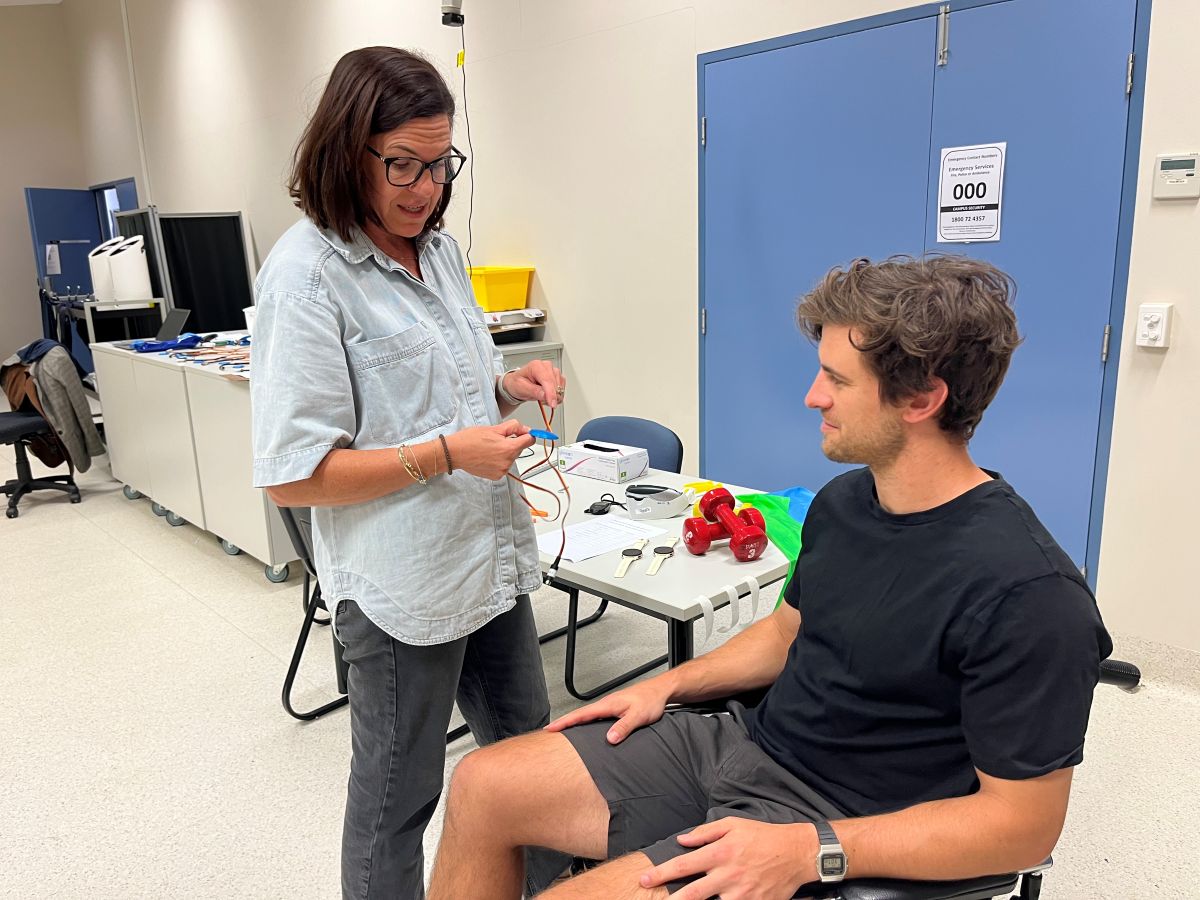
The next phase of the study has already begun, expanding into more active wheelchair activities. Photo: Mandy Atkinson
What this means for real life
Lisa is clear that cushion prescription should never be one-size-fits-all.
The cooling cushion costs roughly 20% more than a standard high-needs cushion, and while its thermal benefits are measurable, 44% of participants still preferred the air cushion overall. Some found the cooling sensation uncomfortable. Pressure redistribution, comfort, and thermal management each pull in different directions - and the right balance is individual.
Want to help researchers understand what we’re up against in the heat?
If you're able-bodied, aged 18-50, physically active, and free of pressure injury history or temperature regulation issues, and can spare 3 hours, we’d love to hear from you.
Contact Lisa at lisa.couzens@scu.edu.au.
Ethics approval 2023/005.