
/prod01/channel_8/media/scu-dep/current-students/images/Coffs-harbour_student-group_20220616_33-147kb.jpg)
/prod01/channel_8/media/scu-dep/current-students/services/counselling/images/RS21533_English-College-Student_20191210_DSC_6961-117kb.jpg)
/prod01/channel_8/media/scu-dep/study/scholarships/images/STEPHANIE-PORTO-108-2-169kb.jpg)
/prod01/channel_8/media/scu-dep/study/arts-and-humanities/images/RS20958_Chin-Yung-Pang-Andy_20190309__79I5562-960X540.jpg)
/prod01/channel_8/media/scu-dep/experience/images/SCU-INTNL-STUDY-GUIDE-280422-256-72kb.jpg)
/prod01/channel_8/media/dep-site-assets/component-library/screenshots/online-1X1.jpg)
/prod01/channel_8/media/scu-dep/news/images/2026/Flood-waters-in-Lismore-streets_March-2022-2000X972.jpg)
The flood exposed many things, including our unimaginative approach to managing waste. As immediate recovery moved into reconstruction, we saw an opportunity to manage this flood-damaged material differently.
We proposed an alternative to traditional house demolition. It was piloted on two flood-damaged houses in Lismore, using a “circular” model that could reuse materials and eliminate waste.
As well offering potential economic benefits for the local community, our report it had considerable social and environmental value.
Why did homes get demolished?
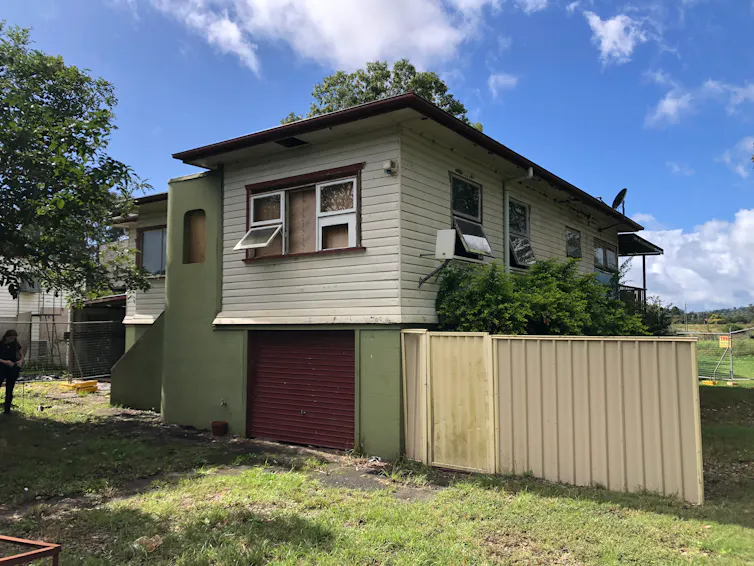
In the aftermath of the floods, many NSW homes were significantly damaged and still lay in the path of future floods. In response, the NSW government introduced for eligible homes in flood-prone areas.
Part of this program involved demolishing homes, with the materials discarded in landfill or used for low-value recycling, such as woodchipping and burning. Yet the homes contained valuable materials, such as hardwood timbers.
Losing these homes was traumatic for and an unnecessary loss of valuable resources. So the NSW Reconstruction Authority, , and the University of Technology Sydney (UTS) explored how to recover a material that is extremely difficult to source today – old growth timber.
The colonial hunger for hardwood
The first wave of European colonisation of the Northern Rivers included groups known as “”. These timber cutters arrived in search of highly-prized rainforest hardwoods.
Much of this timber was transported to Australian cities or as far away as Europe. It was also used to construct buildings and homes for local communities.
Premium old growth timbers extracted from the area included red cedar (Toona ciliata), spotted gum (Corymbia maculata), tallowwood (Eucalyptus microcorys), rosewood (Didymocheton fraserianus) and blackbutt (Eucalyptus pilularis).
This is not your ordinary hardware-variety timber. Prized hardwood rainforest timber is dense, strong, durable and resistant to rot and insects.
The circular timber project
In early 2024, the developed an alternative to traditional demolition, which offers very little opportunity for recovering materials.
The current system for demolishing homes is this: large-scale machines level structures and excavators scoop materials into dump trucks, which transport them to distant landfill. Sometimes, materials are recovered, but the vast majority are broken into small pieces, trucked away and buried.
We wanted to establish a “circular” system that reused materials and eliminated waste. This cannot be achieved by a single entity – multiple partners needed to collaborate. In this case, the local community, educators, businesses and government agencies collaborated to establish a pilot where timber from uninhabitable homes could be recovered and reused.
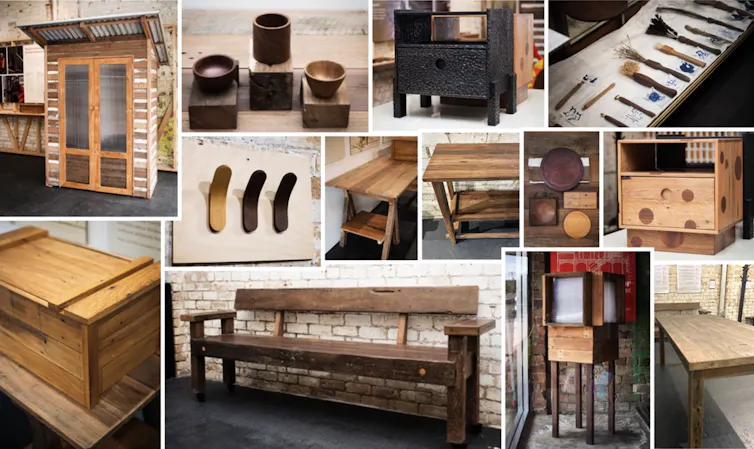
The local community was invited to make prototypes as proof that these premium timbers could be salvaged into new objects. Buy-in from the community was immediate – the materials in these homes represented a link to the region’s history and culture.
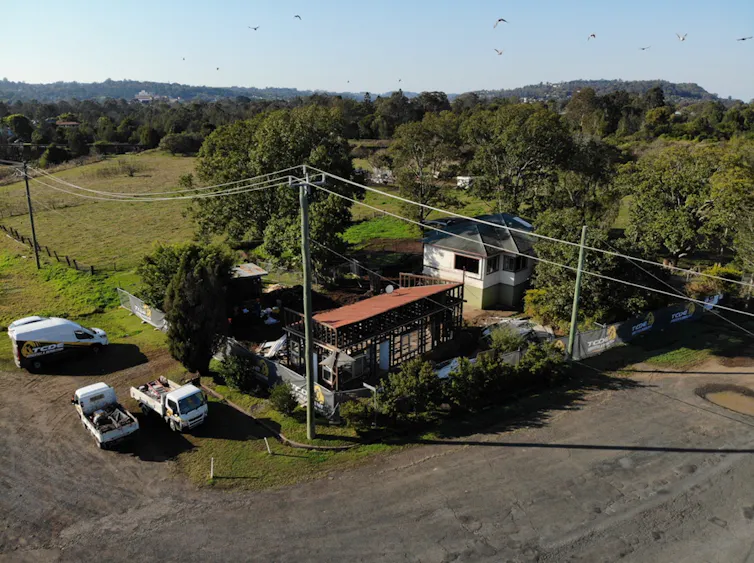
Two homes acquired by the government authority were deconstructed, with their recovered materials made available to local timber makers, builders, artists, architects and designers. The salvaged timber was transformed into a dining table, a community shed, and other designed objects.
How it happened
Moving from home demolition to deconstruction represented a significant challenge. There are for demolishing a building, but no guidelines for deconstructing exist (yet).
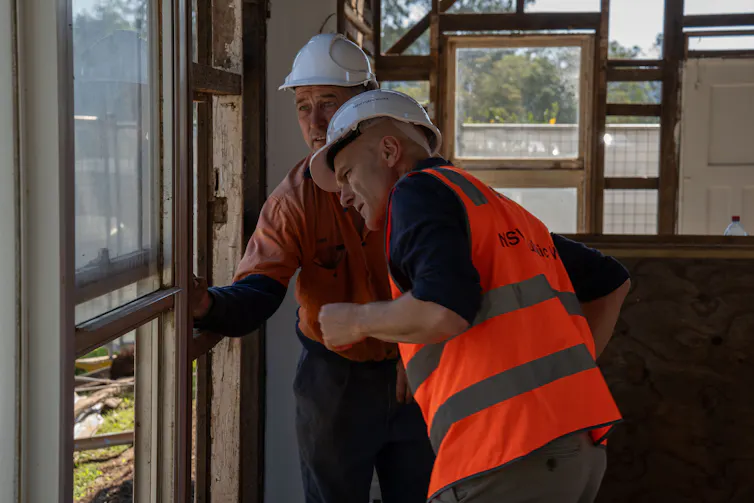
This project developed a considered approach to dismantling the homes. Care was taken in site preparation, materials identification and disassembly to ensure as much of the timber was recovered as possible.
Although deconstructing, recovering and reusing house materials requires more time, there were significant . For example, salvaging timber reduces carbon emissions, significantly reduces waste sent to landfill, and has a smaller carbon footprint than using virgin timber.
There are also economic and social benefits. This was a Northern Rivers community with a long history of seeing lives turned upside down by catastrophic floods. They responded positively to retaining the physical, cultural, and historical value of the past built into these homes.
Homes hold many values
Between 2019 and 2025, there were 214,483 approvals granted nationwide for knock-down-and-rebuild , with the management of waste material left to the discretion of the owner and demolition contractor.
A standard Australian house can include salvageable materials such as hardwood timber, premium timbers, pressed metal ceilings or Federation red bricks.
Shifting our approach from demolition to deconstruction could open up new opportunities. Not only could it create jobs, but it could reduce the need for virgin materials and protect our environment.
This project reminds us that value should not only be assessed in economic terms but also in relation to our environment and communities. This program showed deconstructing homes can be embraced as a way to transform waste into a valuable resource.
, Associate Professor, Product Design, ; , Design Researcher, , and , Director, The Living Lab Northern Rivers, Office of Pro Vice Chancellor (Research and Education Impact),
This article is republished from under a Creative Commons license. Read the .