
/prod01/channel_8/media/scu-dep/current-students/images/Coffs-harbour_student-group_20220616_33-147kb.jpg)
/prod01/channel_8/media/scu-dep/current-students/services/counselling/images/RS21533_English-College-Student_20191210_DSC_6961-117kb.jpg)
/prod01/channel_8/media/scu-dep/study/scholarships/images/STEPHANIE-PORTO-108-2-169kb.jpg)
/prod01/channel_8/media/scu-dep/study/arts-and-humanities/images/RS20958_Chin-Yung-Pang-Andy_20190309__79I5562-960X540.jpg)
/prod01/channel_8/media/scu-dep/experience/images/SCU-INTNL-STUDY-GUIDE-280422-256-72kb.jpg)
/prod01/channel_8/media/dep-site-assets/component-library/screenshots/online-1X1.jpg)
What outcomes parents should expect from early childhood education and care
Categories
Share

,
Parents often have different expectations for their three- to five-year-old children when they attend an early learning centre. Some parents expect their child to engage in academic learning activities or “”. Academic activities are associated with formal school-based learning such as writing, reading and knowing their numbers.
Parents are to feel concerned if they visit their friend’s home and see their friend’s child brings home worksheets (for example dot-to-dot of their name, colouring in of Easter eggs, or other adult-directed products) from their early childhood centre. They may worry their child is being left behind because their child is “only playing” and not engaging in real learning.
Other parents focus on their child where children make choices about what they will play. are supported by educators who are responsive to the child, and socially construct the child’s play.
Read more:
The tension lies between teacher-directed activities where children are perceived to be doing “real learning”, as opposed to children making choices to play according to their interests.
So, what should three- to five-year-olds be learning?
Developmental milestones provided by the Australian Children’s Early Childhood Quality Authority () state:
Children’s learning is ongoing and each child will progress towards the outcomes in different and equally meaningful ways.
This covers five domains of learning, which is linked to the curriculum and the National Quality Standards:
-
physical
-
social
-
emotional
-
cognitive
-
language development.
The checklist indicates what a child should be able to do by a certain age, and this is linked to the early childhood education curriculum.
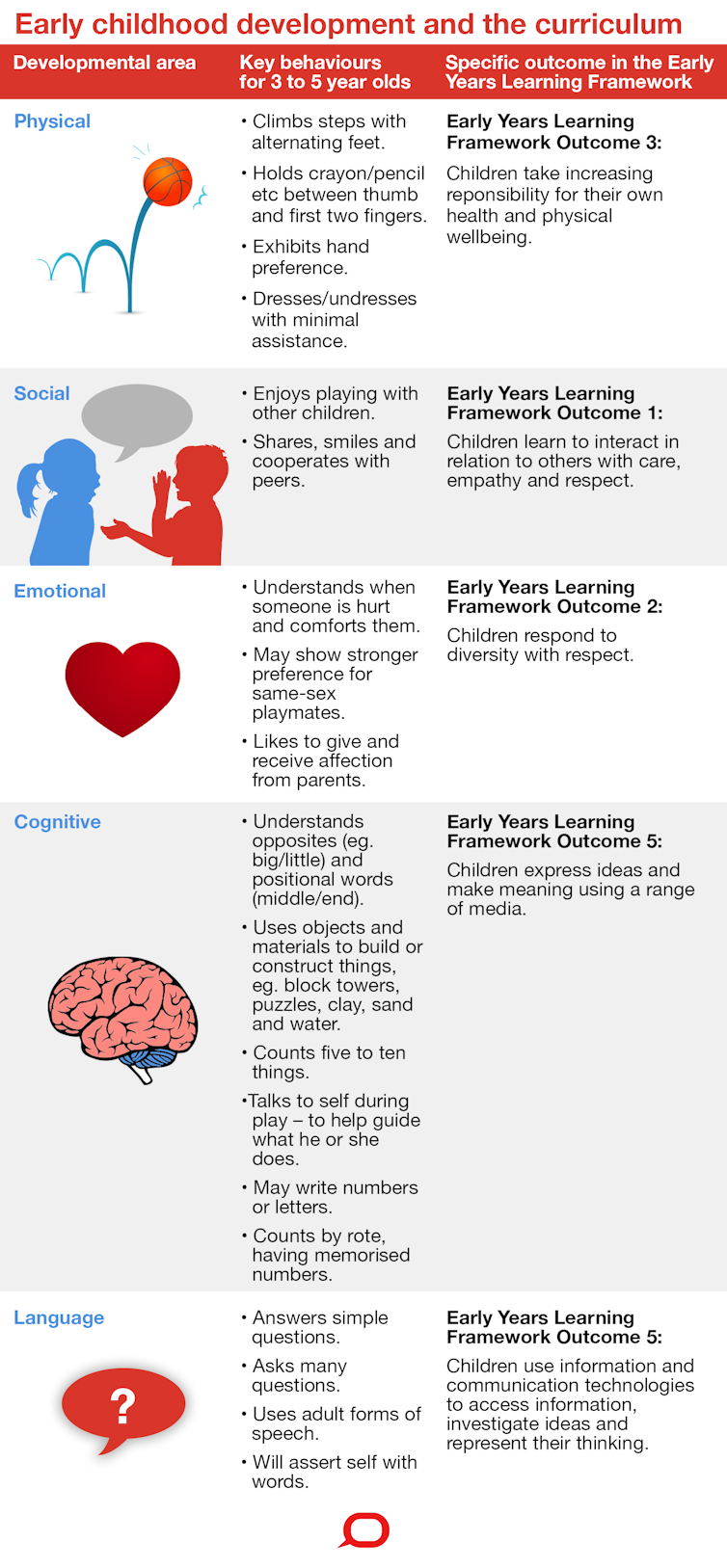
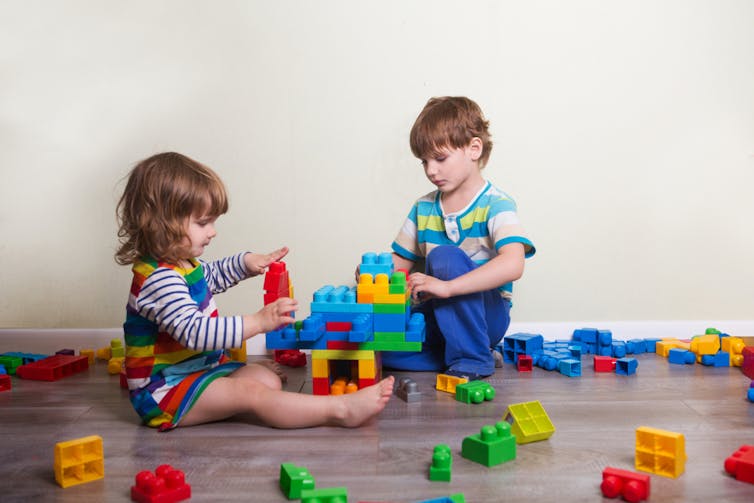
demonstrates children’s learning achievements are greater from play-based programs, which include activities such as block building, compared to early childhood programs that have an academic focus.
The early childhood education curriculum emphasises the importance of play-based learning and demonstrates children’s learning achievements are greater from play-based programs compared to early childhood programs that have an academic focus.
When to worry
According to the developmental milestones, parents should seek advice from a professional if their three- to five-year-old child:
-
is not understood by others
-
has speech fluency problems or stammering
-
is not playing with other children
-
is not able to have a conversation
-
is not able to go to the toilet or wash him/herself.
Parent-teacher relationships are important
Educators need to be able to explain their approach to children’s learning to parents at the outset of the child/family’s admission to the centre and reinforce this as children learn and develop.
The curriculum and the National Quality Standards both focus on educators having “partnerships with families”. But if there is disagreement about what and how children should be learning, a partnership between the parents and teachers won’t develop and endure.
Read more:
 Parents need to be continuously informed about the learning program in the centre. There needs to be alignment between parents’ expectation of what their child will learn in an early childhood centre, with the learning program provided, and the play-based approach a good one for the children.
, Senior Lecturer, School of Education,
This article was originally published on . Read the .
Keep reading
All Media ReleasesThe Conversation: New museum find shows nature can’t stop inventing seahorses
/484x0:1516x1032/prod01/channel_8/media/scu-dep/news/images/2026/TC_seahorses_Hero-news-art---2000px-x-1032px.png)
糖心传媒 to lead $4 million national coffee research program
/484x0:1516x1032/prod01/channel_8/media/scu-dep/news/images/Coffee-Program-Launch.jpg)
/514x0:1487x973/prod01/channel_8/media/scu-dep/news/images/2026/Yirrganydji-Aboriginal-woman-hand-assorting-fruit-and-seeds-food-iStock-610662162-2000X973.jpg)
/514x0:1487x973/prod01/channel_8/media/scu-dep/news/images/2026/Bush-fire-near-Stacks-Bluff-in-Tasmania-credit-Matt-Palmer-kbTp7dBzHyY-on-Unsplash-2000X973.jpg)
From a farming family in India to tackling a global food-security challenge
/896x0:3200x2304/prod01/channel_8/media/scu-dep/research/images/Experimental-rice-crop_20230411_DSC_0516_16-9.jpg)
/514x0:1487x973/prod01/channel_8/media/scu-dep/news/images/2026/Men-making-fishing-net-using-string-created-by-women-P_20240314_114001-credit-Wanda-Hill-2000X973.jpg)
/514x0:1487x973/prod01/channel_8/media/scu-dep/news/images/2026/Jagun-stringmaking-at-Living-Lab-on-2024-Jan-24-credit-A-Lush-Forest-Media-2000X973.jpg)
Small but mighty dung beetles take a big bite out of farm methane
/514x0:1487x973/prod01/channel_8/media/scu-dep/news/images/2026/Dung-beetles-on-cow-manure-credit-Gavin-Tinning-2000X973.jpg)
/500x0:2500x2000/prod01/channel_8/media/scu-dep/news/images/2026/pexels-pixabay-46798.jpg)
From new mother to Master's High Distinctions
/484x0:1516x1032/prod01/channel_8/media/scu-dep/news/images/2026/Brittany-Masthead.jpg)